Tabs Studio Blog (organizing Visual Studio document tabs)

September 18, 2009

Floating tab groups in Visual Studio 2008?

Filed under: Uncategorized — Sergey Vlasov @ 8:10 am

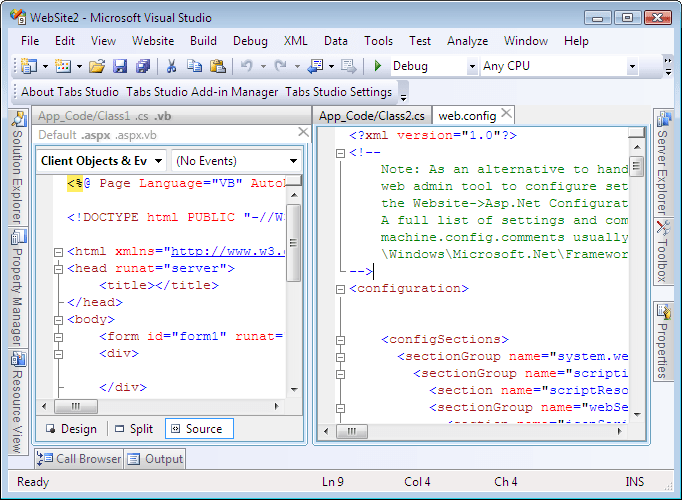
I’m experimenting with detachable tab groups in Tabs Studio. It’s extremely brittle and limited, but some things work:

Two standard vertical tab groups in Visual Studio 2008

Two standard vertical tab groups in Visual Studio 2008


New floating tab group window and main Visual Studio 2008 window

New floating tab group window and main Visual Studio 2008 window


It might be useful in multi-monitor setup. I don’t have personal experience with multi-monitor environment. Listening to the buzz about floating code windows in Visual Studio 2010, I hear that some say how cool it is and some say they can successfully utilize their multiple monitors with Visual Studio 2008 already.

What do you think about the floating tab groups in Visual Studio 2008 idea?

September 15, 2009

Color Icons add-in

Filed under: Uncategorized — Tags: — Sergey Vlasov @ 9:38 am

I use less distractive “gray theme” icons in Tabs Studio context menu. Now that context menu is completely customizable, I’ve created an alternative color icons pack:

Custom icons in tab context menu

Custom icons in tab context menu


Color Icons add-in monitors two tab context menu events and replaces default icons in context menu with icons from its own resources. Color Icons’ icons are stored in Icons folder with Build Action set to Resource in file properties. Each image has resolution 96 dpi and size 16*16 pixels.

You can also replace default close tab button image with the one from ColorIcons.dll using following style:

<Style TargetType="TabsStudio:CloseTabButton" BasedOn="{StaticResource DefaultCloseTabButtonStyle}">
    <Setter Property="Source" Value="pack://application:,,,/ColorIcons;component/icons/close_tab.png"/>
</Style>

Custom close tab button image

Custom close tab button image


You can also use file path (or even website URL) to describe where the custom image is located:

<Style TargetType="TabsStudio:CloseTabButton" BasedOn="{StaticResource DefaultCloseTabButtonStyle}">
    <Setter Property="Source" Value="file://c:/close.png"/>
</Style>

Download Color Icons v1.0.0 for Tabs Studio v1.6.2.

Sync add-in

Filed under: Uncategorized — Tags: — Sergey Vlasov @ 8:31 am

Occasionally, I need to find one of the currently opened documents in Solution Explorer. To fulfill this necessity and to demonstrate Tabs Studio context menu extensibility I’ve created Sync add-in.

Visual Studio has the Track Active Item in Solution Explorer option that constantly syncs Solution Explorer with the currently opened document:

Track Active Item Viusal Studio option

Track Active Item Viusal Studio option


Visual Studio also has the View.TrackActivityinSolutionExplorer command that acts as a toggle for this option. With Track Active Item in Solution Explorer option turned off you can call View.TrackActivityinSolutionExplorer command twice to locate currently opened document in Solution Explorer window (if Solution Explorer window is opened).

Alternatively, Sync add-in adds the new Sync with Solution Explorer command to tab and tab extension context menus. It allows locating any opened document (not only current) and activates Solution Explorer window if it is not opened:
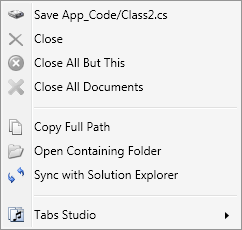
Sync with Solution Explorer tab extension context menu command

Sync with Solution Explorer tab extension context menu command


Sync monitors both OpeningTabExtensionContextMenu and OpeningTabContextMenu events:

engine.OpeningTabExtensionContextMenu += OpeningTabExtensionContextMenu;
engine.OpeningTabContextMenu += OpeningTabContextMenu;

In OpeningTabExtensionContextMenu it checks that TabExtension has Document and ProjectItem associated with it (to show Sync command only for document windows), stores TabExtension for later processing (if user chooses Sync command from the menu) and places the new Sync menu item after the Open Containing Folder item:

private void OpeningTabExtensionContextMenu(object sender, 
    TabsStudioExt.OpeningTabExtensionContextMenuEventArgs e)
{
    try
    {
        if (e.TabExtension.Window.Document == null || e.TabExtension.Window.Document.ProjectItem == null)
            return;
    }
    catch (System.Exception)
    {
        return;
    }
    storedTabExtension = e.TabExtension;
    PlaceMenuItem(syncTabExtensionMenuItem, e.ContextMenu);
}

To exactly place the new menu item, Sync scans all context menu items looking for the control with the OpenContainingFolder name and inserts the new item after it:

private void PlaceMenuItem(System.Windows.Controls.MenuItem menuItem,
    System.Windows.Controls.ContextMenu menu)
{
    foreach (object item in menu.Items)
    {
        if (item is System.Windows.Controls.Control)
        {
            if ((item as System.Windows.Controls.Control).Name.Equals("OpenContainingFolder"))
            {
                menu.Items.Insert(menu.Items.IndexOf(item) + 1, menuItem);
                break;
            }
        }
    }
}

When user chooses the Sync menu command, Solution Explorer window is activated, associated project item is made visible using the ExpandView method and associated element in the Solution Explorer tree is selected:

private void SyncTabExtension(object sender, System.Windows.RoutedEventArgs e)
{
    try
    {
        EnvDTE.UIHierarchy solutionExplorer = dte.ToolWindows.SolutionExplorer;
        solutionExplorer.Parent.Activate();
        EnvDTE.ProjectItem projectItem = storedTabExtension.Window.Document.ProjectItem;
        projectItem.ExpandView();

        EnvDTE.UIHierarchyItem hierarchyItem = 
            FindHierarchyItem(solutionExplorer.UIHierarchyItems, projectItem);
        if (hierarchyItem != null)
            hierarchyItem.Select(EnvDTE.vsUISelectionType.vsUISelectionTypeSelect);
    }
    catch (System.Exception)
    {
    }
}

When Sync command is invoked for a tab, all extensions in this tab are selected in the Solution Explorer tree.

Download Sync v1.0.0 for Tabs Studio v1.6.2.
Tabs Studio v1.6.2 is released

Filed under: Releases — Sergey Vlasov @ 6:29 am

Tabs Studio v1.6.2 is released – added ability to customize tab context menu from an add-in.

September 14, 2009

Customizing tab context menu from an add-in

Filed under: Uncategorized — Tags: — Sergey Vlasov @ 9:43 pm

In the next Tabs Studio version I’ve added two new events that occur just before tab context menu is opened:

namespace TabsStudioExt
{
    public interface ITabsStudioEngine
    {
        ...
        event OpeningTabContextMenuEventHandler OpeningTabContextMenu;
        event OpeningTabExtensionContextMenuEventHandler OpeningTabExtensionContextMenu;
    }
}

OpeningTabContextMenuEventArgs contains the System.Windows.Controls.ContextMenu ContextMenu property, Tab and Tabs properties. OpeningTabExtensionContextMenuEventArgs contains the ContextMenu, TabExtension, Tab and Tabs properties. An add-in can add, remove and modify menu items in the context menu based on TabExtension or Tab it was opened for. Right click on a tab with a single extension generates the OpeningTabExtensionContextMenu event.

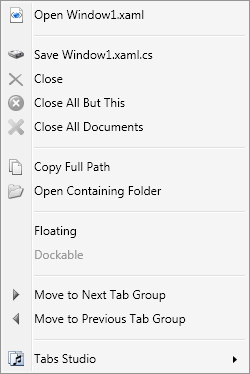
To simplify customization from an add-in, each menu item and separator in the default context menu was given a Name. For document tab context menu the names are: Open, OpenSeparator, Save, Close, CloseAllButThis, CloseAllDocuments, FileSeparator, CopyFullPath, OpenContainingFolder, VS2010DocumentSeparator, VS2010Floating, VS2010Dockable, TabGroupsSeparator, MoveToNextTabGroup, MoveToPreviousTabGroup, TabsStudioSeparator and TabsStudio:

Document tab context menu

Document tab context menu


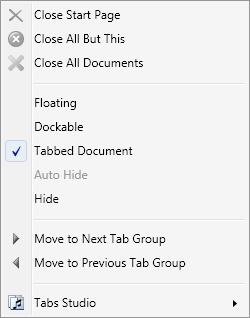
For non document tab context menu additional names are: WindowSeparator, Floating, Dockable, TabbedDocument, AutoHide and Hide:
Non document tab context menu

Non document tab context menu

September 12, 2009

Tabs Studio v1.6.1 is released

Filed under: Releases — Sergey Vlasov @ 6:34 am

Tabs Studio v1.6.1 is released – added the Open add-ins directory button to the Add-in Manager dialog, fixed sharing violation accessing registration info file when opening several Visual Studio instances at the same time.

September 11, 2009

Opening add-ins directory

Filed under: Uncategorized — Tags: — Sergey Vlasov @ 12:20 pm

For the next Tabs Studio version I’ve added the Open add-ins directory button to the Add-in Manager dialog:

Open add-ins directory button in the Add-ins Manager dialog

Open add-ins directory button in the Add-ins Manager dialog


This button creates the TabsStudioAddins directory if it doesn’t exist and opens it in Windows Explorer:
TabsStudioAddins directory in Windows Explorer

TabsStudioAddins directory in Windows Explorer


Installing and removing add-ins should be easier now – no need to search for the TabsStudioAddins directory on the disk yourself.

September 4, 2009

Tabs Studio v1.6.0 is released

Filed under: Releases — Sergey Vlasov @ 8:02 am

Tabs Studio v1.6.0 public is released – no changes comparing to v1.5.7.

September 2, 2009

Decorator add-in

Filed under: Uncategorized — Tags: , — Sergey Vlasov @ 7:14 pm

Decorator is an example of custom properties usage. It sets distinct color for tabs that belong to the project having the most opened tabs. I.e. if 2 opened tabs are for documents from Project1, 5 tabs from Project2 and 3 tabs from Project3, then tabs from Project2 will be colored blue.

TabsStudioDecorator.Properties class defines custom dependency property IsTopProjectProperty, registers it using the RegisterAttached method and provides two static set and get methods for it.

Main Decorator class recalculates the top project when a tab is created or destroyed. Then it sets IsTopProjectProperty to true for all tabs belonging to the top project (if number of tabs in the top project is greater than 3) and to false for the rest of tabs.

Main Decorator class also implements the TabsStudioExt.IStyler interface and returns definition for the TabsStudioDecorator namespace from the GetNamespacesForResourceDictionary method.

Following style is used to color top project tabs that are not currently selected to white-blue gradient:

<Style TargetType="TabsStudio:Tab" BasedOn="{StaticResource DefaultTabStyle}">
    <Style.Triggers>
        <MultiTrigger>
            <MultiTrigger.Conditions>
                <Condition Property="TabsStudioDecorator:Properties.IsTopProject" Value="True"/>
                <Condition Property="IsTabSelected" Value="False"/>
            </MultiTrigger.Conditions>
            <Setter Property="Background">
                <Setter.Value>
                     <LinearGradientBrush StartPoint="0,0" EndPoint="0,1">
                         <GradientStop Color="#F5F5F5" Offset="0"/>
                         <GradientStop Color="#B0B0F0" Offset="1"/>
                     </LinearGradientBrush>
                </Setter.Value>
            </Setter>  
        </MultiTrigger>
    </Style.Triggers>
</Style>
Four tabs belonging to WebSite2 project are colored blue

Four tabs belonging to WebSite2 project are colored blue

Download Decorator v1.0.0 for Tabs Studio v1.5.7.

Disambiguator add-in

Filed under: Uncategorized — Tags: — Sergey Vlasov @ 12:25 pm

Files in different projects and even files within a project can have the same names. In this case their tabs also have the same titles and one need to hover the mouse over the tabs to distinguish them by tooltip with the full path. Disambiguator add-in detects when two or more tabs have the same title and adds Visual Studio folder or project to titles for these tabs.

Disambiguator monitors TabCreated event, searches if tabs with the same name without extension already exist and adds TitleTransform to tabs found except if tab already has TitleTransform with the [Disambiguator] tag. The TitleTransform prefixes the title with the Visual Studio folder or project name (if document is not within a folder). A web site project has a full path as its name, so Disambiguator uses only last directory name in the title in this case.

Download Disambiguator v1.0.0 for Tabs Studio v1.5.7.

« Newer PostsOlder Posts »

Blog at WordPress.com.